Showing posts with label classroom environment. Show all posts

Monday, August 28, 2023

The Science of Reading


The Science of Reading is an educational finding, based on research, which attempts to unravel how humans become literate. Many school districts in the nation are currently embracing the findings and implementing them into elementary school classrooms. The basic premise is that educational institutions have gotten reading instruction all wrong and an update in the operating system is necessary and overdue. 

All of this is beautifully presented in a podcast entitled Sold a Story by Emily Hanford. I listened to all 6 episodes yesterday on my drive from Rochester, NY to Trenton, NJ. It is an engaging investigation into reading theory, history, and implementation. It should be required listening for educators, especially those who have not gotten this information in their training programs.

As a reading specialist, I already knew most of the information. Yet, there were some surprises (I'll get to that in a minute). I've lived through a range of the educational approaches about reading presented in this podcast. I remember phonics-based instruction as a child with worksheets asking me to circle the long vowel in a series of words. I also remember my confusion because I was never told what that meant. What made a vowel long or short? A bit of explicit instruction would have been helpful and my early experience influences my teaching today because I know what it is to be the child who benefits from explicit instruction. 

Over the years, the pendulum has swung between phonics-based instruction to wholistic methods and back again. Things shift as we learn more and, it seems to me, they shift because people simply want something different. We also cannot ignore the influence of financial greed and political gain in how schools are run. All of this is covered in Sold a Story.

The bottom line is many schools are now throwing out the work of Marie Clay, Lucy Calkins and Fountas & Pinnell to focus on phonics. In my training and work with hearing students, I've always incorporated phonics instruction and was surprised to learn -  in the podcast - that Marie Clay's Reading Recovery and Fountas & Pinnell's Leveled Literacy Intervention considered it optional.  That was never how I implemented their work. For this, I give thanks to my mentor, Dr. Joanna Uhry, who taught me the value of matching my instruction to meet the needs of the children rather than providing a one-size-fits-all approach. 

This "new" direction, propelled by the science of reading, comes with questions. Questions regarding assessment and instruction that administrators and coaches, who know much less than I do, are undoubtedly going to struggle to answer. I just hope we do better for our struggling readers and can one day celebrate an America with higher literacy rates because to paraphrase Whoopi in Ghost, we in danger girl.

Tuesday, January 4, 2022

COVID and NYC Public Schools

United Federation of Teachers (UFT) President Michael Mulgrew holds a press conference outside of PS347 alongside our Chapter Leader, Michael Nappi. 

The Omicron variant is taking a bite out of New York City public schools. Everyday we get updates about classroom closures, quarantines, and changing protocols. The Department of Education (DOE) and the UFT are doing everything they can to keep schools open. It is certainly an ongoing challenge. 

A concern at the moment is that teachers are "dropping like flies" (as my friend Maria says). As educators test positive and isolate, schools are threatened with understaffing. If the positivity rate continues to increase there may be no other choice but to go remote. It is an option being fought at every turn.

To address this issue, and others, UFT President Michael Mulgrew held a press conference outside of our school yesterday morning. He outlined the new procedures, which include increased testing for teachers and students, the distribution of home testing kits, and a beefed-up situation room to test and trace.

Quarantine and isolation are basically a thing of the past for those in close contact with someone who has tested positive (that's where the home testing kits become key in determining safety). Folks with symptoms also rely on the rapid tests in order to judge whether or not they can return to school. 

Our Dean of Students, John Marro, takes students' temperatures as they arrive on the first day back after holiday break, Monday, January 3, 2022.

I feel sometimes like I've walked through a minefield and have successfully navigated my way across dangerous terrain, but a misstep is bound to happen. I am vaccinated and boostered, covered in hand sanitizer (or "hanitizer" as the kids say), masked, and distanced. But, I'm also working with kindergarten children who have a casual relationship with masks, like to hug, and often place little fingers in little mouths and noses. That and a four-hour daily commute on public transportation gives one pause. Although, I am somehow not making myself crazy over any of it. 

This too shall pass. 

Saturday, November 27, 2021

SEL & SJE

For a while there I was really into vampires. In all of the books, movies, and shows I consumed vampires faced the dilemma of living forever. What do you do with all that time? 

It seems that they'd have to reinvent themselves again and again to keep things interesting. I imagine an enterprising vampire would always have to create new goals to stave off the recurring barrage of monotony. 

My long teaching career can be likened to the vampire's challenge. In order to keep things interesting I'm always tackling new areas in the educational arena. When I started teaching, my focus was on learning American Sign Language (ASL) and Deaf culture. That kept me on my toes for many, many years. As I became more knowledgeable and skilled, I took a deep dive into literacy development. The marriage of the two became the focus of my dissertation. It is where my heart beats and I continue to pursue it, but it's become part of me. It doesn't hold the same immediacy that it once did. I've earned the right to say I know a lot.

Over the past several years, I've begun to explore how the things I've learned connect with Social Emotional Learning (SEL) and Social Justice Education (SJE). I'm finding this is an area that is calling out to me. It isn't just because it's fascinating, it's because it's needed. 

Consider my week last week. I returned from lunch to find a child sitting in my classroom with our Dean of Students. My kindergarten student became angry during lunch (the kindergarten students eat in the classroom) and had a tantrum. Fried potatoes, broccoli, and chicken were scattered on the tables and floor. Small pieces of potato were mashed into the rugs, book bins were tossed, pencils strewn, crayons broken, an open bottle knocked over on a table dripped water into a large puddle on the floor, and a very angry boy sat with his arms crossed on the floor.

I knew immediately what to do. I've watched our former social worker, Melanie, talk with students in this situation before and emulated her approach. I also brought in our daily work with mindfulness and breathwork. I pulled from my knowledge of this boy and how he responds best to feeling safe rather than challenged. He slowly shared his feelings with me and I listened. I gave him other options for expressing his anger. We continued to talk as he helped me clean the room. A connection of trust was growing and although I realize these outbursts will occur again, I do believe he will develop the mechanisms over time to deal with his anger in a healthier way.

Two days before this, another boy was hurt on the playground. He was scared, so was I. He had a very nasty bump developing over his eyebrow and it freaked me out. He suddenly looked very little. Still, the things I've learned kicked in and he was comforted and safe. It seems my role as an educator these days requires more and more of this type of thing. 

The Six Elements of Social Justice Education
(Click to enlarge)

It happens in the moment - as in the examples above - and in the teaching. Social and Emotional Learning and how it relates to Social Justice Education is something that has captured my interest. 

I teach a Children's Lit course at Fordham University and have had fantastic opportunities to talk with some incredibly passionate students about it. Our discussions push my thinking and bring me insights I wouldn't have realized on my own. 

I'm able to integrate SJE into the work I do with my Broadway Books First Class program. It's exciting work. It's important work. It's the kind of work that keeps vampires and educators on their toes. In this season of gratitude, I'm thankful I continue to have things to motivate and interest me. I have so much more to learn. May the passion never cease. 

Friday, September 4, 2020

Back to School(ish)

Anxiety mounts as the countdown brings us closer to the start of another school year. This one, my 25th, is like no other. It is filled with questions ranging from the school calendar (there isn't one), to safety protocols, student rosters, learning models, curriculum, and the coordination of all these elements. There are so many unknowns. 

Thankfully, this past week we had some answers. It seems a strike, which has been weighing heavily on my mind, has been averted. The NYC DOE, mayor's office, and the UFT came to an agreement that would provide some safety measures for students and staff. I still report in-person at my school on September 8, 2020, but students (originally scheduled to start on September 10) won't begin classes now until September 21. That will give schools time to get their act together, I hope. 

My school selected the A, B, C, D plan encompassing blended and fully remote learning. This means, as far as I understand, that I have some students on my first grade roster that I will never see. Children whose parents opted for fully remote learning (Group D) will work with a fully remote teacher (not me and not yet assigned). I'm not sure how that plays out for my Deaf and hard of hearing students. I suppose a sign language interpreter will work alongside the teacher to facilitate communication. It's not ideal (especially when I can provide instruction in the child's first language of ASL), but these are extraordinary times. 

The rest of the class - my blended learning students - are split into A, B, and C groups. I see just one group a day in our socially distant, mask-wearing, classroom. Let's see how long first graders can follow those rules. That means I see them only once or twice a week. The other days they work with a "blended remote teacher." Confused? It'll be a lot to coordinate. 

There are so many challenges, yet, I feel more than ready to tackle them. Remote learning, which I did with my class from March - June, was difficult and (mostly) unfulfilling. I kept reminding myself that we were all doing our best in a horrible situation, it is temporary, etc. 

I want to go back to my classroom. I want to build a community of learners (no matter how small each day), and I want to feel the joy that teaching brings me. Alas, I don't want to die for it and I have my fingers crossed that all will go well, but it's a risk. A risk I have no power to avoid or refuse.

Details continue to be worked out. I'm very anxious. I am skeptical. But, I am also determined to be the person my students need me to be right now. Given all the pain I've encountered this year, I believe getting back to what I love will also help heal my sorrow a bit. At least, I hope so. 

Back to school 2020. This is one like no other. Wish us luck. 

Wednesday, September 4, 2019

Year 24!

I am energized and excited. I'm entering my 24th year as an educator! I'll be teaching kindergarten in a new room - well, I spent 5 years in this room, but that was years ago - with a new team teacher and a class of fantastic, adorable, fun students. Lucky me!

I've spent the past few days moving in and setting up. Here is pictorial documentation of the process.

Tuesday, August 27, 2019
The move from my old classroom on the first floor to my new room on the second.

Monday, September 3, 2019
Making a bit of progress. You can see more of the floor.

Monday, September 3, 2019
Playing around with spacing, trying to decide on a floor plan.

Monday, September 3, 2019
The day is over. One final pic before leaving. We've decided on the layout.

Tuesday, September 4, 2019
Making progress, but realizing we have way too much stuff.

Tuesday, September 4, 2019
"By George, I think we've got it." We've created some little nooks for reading, a space for blocks that is out of the way of traffic and can therefore stay up for days and days, and a magnificent library. 

Tuesday, September 4, 2019
One final shot before walking out the door. Tomorrow this room will be alive with the energy of little children.

Sunday, March 24, 2019

Putting It Together

Artist Sean Baptist's sketch for the "window" in our dramatic play area

In Sunday in the Park with George the titular character sings about the process of making art.

Bit by bit, putting it together
Piece by piece, only way to make a work of art
Every moment makes a contribution
Every little detail plays a part

Ounce by ounce, putting it together
Small amounts, adding up to make a work of art

Putting it together, that's what counts!

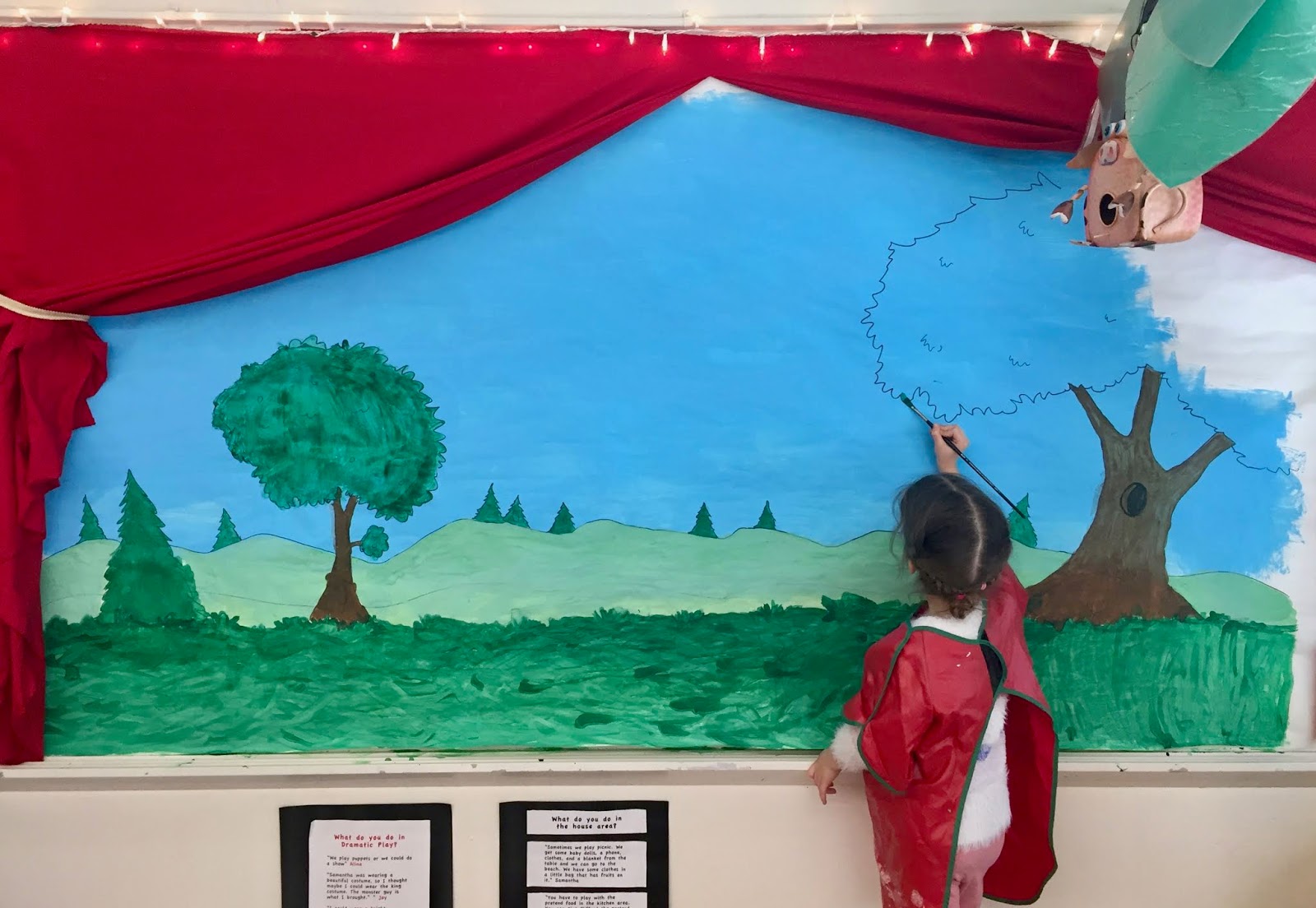
We experienced this first-hand when the children had the notion to create a window in the dramatic play area. They envisioned a landscape with grass, flowers, and trees. A place where magical animals roamed and frolicked in the sunshine.

We shared their vision with our teaching artists from the Children's Museum of the Arts  - Katya, Zuzia, Ian and Sean Baptist - and they helped us execute a plan. Sean began with a quick sketch for the children to approve (see above) and we set to work. It has now morphed into the backdrop for a stop-motion animated movie, which we've already begun.

Here are some photographs of this work in progress.

Sean brings his sketch to life


The painting begins!


The sketch is made permanent with a Sharpie


After mixing colors to find the right shade, children begin to paint the foreground


We learned we should make the scenery closest to us the darkest in order to gain the right perspective


Finishing the hat, er...tree


Figuring out the right color for this tree


Things are coming together. Looking good, kids!


It's a nice view from the kitchen table


Finishing touches and an overlay of apples for the trees


The basics are in place
The sun and clouds will appear in the animated movie

Saturday, March 2, 2019

Lockdown in Dramatic Play


School lockdown drills have been a sad reality in our educational system for years. Lockdown drills require teachers to lock the classroom door(s), turn off the lights, open the shades, and gather the students in an area of the room that isn't visible from the hallway. Children hide, stay very quiet, and huddle together until an announcement is made stating the lockdown is lifted. The drills were created in response to horrific incidents of gun violence and murder played out in schools across America.

In September 2012, just before the Sandy Hook Elementary School shooting, my kindergarten students were scared and cried as they propelled a discussion towards the notion of never seeing mommy and daddy again.

In February 2016 my first graders were seemingly less frightend. It appeared lockdown drills were now part of the modus operandi, devoid of an alarming emotional component but just as f@#*%d up as ever.

In 2019 lockdown drills continue, but I learned they are not always initiated by the school administration. This week one preschool child caught my attention when he announced to the other children in the dramatic play area, "The lockdown is now over".

I glanced over and noticed he was looking down at three other 4-year-olds who were crouching down behind the play kitchen. They remained huddled together even after his announcement was made. I was working with another student, so I turned my attention away from them. It wasn't until I got home that I actually processed what I had witnessed.

On the one hand, it is wonderful to see the tenets of dramatic play in full effect. It is through dramatic play that children come to understand the world around them. It gives them agency and is "a great stepping stone for learning to self-regulate their emotions and actions".

But, Lordy! It is so messed up that the realities of hate, mental illness, violence, and easy access to weaponry has resulted in the need for this kind of dramatic play. And it is messed up that it is so commonplace that it took me a day to realize how messed up it is.

Tuesday, September 4, 2018

Year 23!

Good Lord!

Today is the start of my 23rd year as a teacher.  It's thrilling and exhausting but the light has never dimmed, the passion remains. Although the NYC Department of Education didn't make life easy today.  We were given half a day to set up our rooms.

That includes moving all of my stuff from my old classroom into a new classroom, which is a lot after 22 years. It is setting up, cleaning up, cleaning out, SHAMPOOING OUR OWN RUGS (or rather the rugs I inherited, which are a filthy, stained atrocity), hauling out large pieces of unwanted furniture, contacting parents, planning for the week, and making things presentable to welcome the children tomorrow.  All without air conditioning or windows that opened on a hot city day that saw temperatures rise to above 90 degrees.

The good news is...the room is huge and I have a very big closet. Today we got the basic layout in place and in the coming days will add those special touches that say, "Magic happens here".


Wednesday, June 27, 2018

Advice

Ready for some fun in the sun!

As they look ahead to kindergarten, the cool cats of preschool offer some wisdom to their successors.
"You might be sad to say goodbye to Mommy and Daddy but they will pick you up later.  You will like choice time.  You can play blocks and light table.  And gym!" 
"Don't eat too much candy or you will get a stomachache.  And you have to be the boss of your body. Don't burst your friends bubble and touch them too much."
Music with Esther Kim of Tokyo and the Boy
"You have to learn balance.  You can learn to write your name.  I like music.  You should learn music and learn how to dance.  And you can try new foods at lunch.  I like fruits and strawberries.  Apples are good for you.  And go to sleep.  When you wake up it will be time to go home."
"Something I like was the books and reading the news.  If you get a class job you can sign the names of the kids and learn their names in ASL.  You can play at the light table and run at gym.  Be a gentle friend and don't be rough.  And no hitting."
Learning Concept of Word through Shared Reading
"You should play with blocks.  They are fun.  House is fun.  You should draw every day.  And tell the teachers if you need to use the bathroom.  Don't break toys if you want to play with them again."
"Please don't touch the dragon we made. And be careful with other people's artwork because they worked hard on it.  You will like to draw self-portraits and make cards for your Daddy and draw your house or draw yourself instead."
Creating at the Writing Center
 "You should share and play nicely with others."
"In a fire drill there is no time for talking.  We just go fast outside.  It's just practice if you have a fire. And fire can start if you want to make fire with chopsticks and flint.  But you shouldn't."
"Drink water!"
"Play with your friends and HAVE FUN!" 
Playing at The New Victory Theater

Thursday, June 1, 2017

Becoming...

Sketching young Heracles with the pelt of the Nemean Lion at The Metropolitan Museum of Art

Something quietly blossomed this afternoon and it was beautiful - my first graders became a family.

I've noticed this week that the seeds of cooperation, respect, kindness and "oneness" started bearing fruit. One by one and then seemingly all at once this amazing group of children started to move away from their little egocentric tendencies and operate as a unit.

It was evident during reading workshop yesterday when they were scattered around the room quietly reading. A palpable sense of determination and collective joy hung in the air.

Each child applauded the achievements of his or her classmates whose reading assessments indicated they had moved up a level. There were discussions about books. Incredible insights into the author's message being shared on strips of paper and placed into books. Children recommending titles to one another. A sense of purpose prevailed.

These interactions appear to be the cumulation of our time together, which includes lessons in being mindful and taking mind breaks 3 times a day to center our thoughts.

But today we took a trip to the Metropolitan Museum of Art to see sculptures of the Greek heroes we've been studying and the kids impressed the shit out of me.

Sketching Andromeda and the Sea Monster

I think they impressed everyone around us too.

As we gathered around a statue of Andromeda I asked them several questions such as, "Why is she looking up?" and "How is this artist's depiction different from the one you had visualized?  How is it the same?" Their answers prompted onlookers to ask disbelievingly, "How old are these students? What grade is this?" They carried themselves like college students on a museum trip.

Then they sat down to sketch and became fully immersed in the activity. So much so that I was ready to move on long before they were.

On the sidelines two artists sat sketching. Their drawings were not only of the artwork but included my little masterpieces as well. They kindly agreed to share their work with the students and offered tips on how to utilize the paper to maximize the drawing space.

Two kind artists share their sketches
Later, they sat on the ground with a group of children who had questions or who were becoming frustrated with their artistic skills. Role models are everywhere if you keep your eyes open. New York City is a wonderful teacher.

Next, we moved slightly to the left to study Perseus with the head of Medusa. If a bare-breasted Andromeda was cause for giggles and fascination, a naked Perseus seemed even more so.

But that quieted as they set to sketch. We had discussed nudity in art prior to the visit so establishing an openness and artistic viewpoint on the human body beforehand helped minimize - somewhat - the gasps, stares and pointing.

Sketching Perseus with the head of Medusa

However, they captured it all in their sketches.

A child's sketch of an older Heracles cloaked in the skin of the Nemean Lion

We ended the trip with a visit to the rooftop for some very interesting art and an exquisite view of the Manhattan skyline.

Adrián Villar Rojas, The Theater of Disappearance
What a day! The little ones are growing up and I feel like my mom when she says, "I wish I could keep you kids little forever". It always seems like just when things start running smoothly and a class becomes everything a teacher could wish for, they move on.

Still, I have them until June 28 so I'll be practicing mindful appreciation until I have to say farewell.

Wednesday, December 28, 2016

A Broadway Books First Class Visit From Devlin Elliott and Nathan Lane

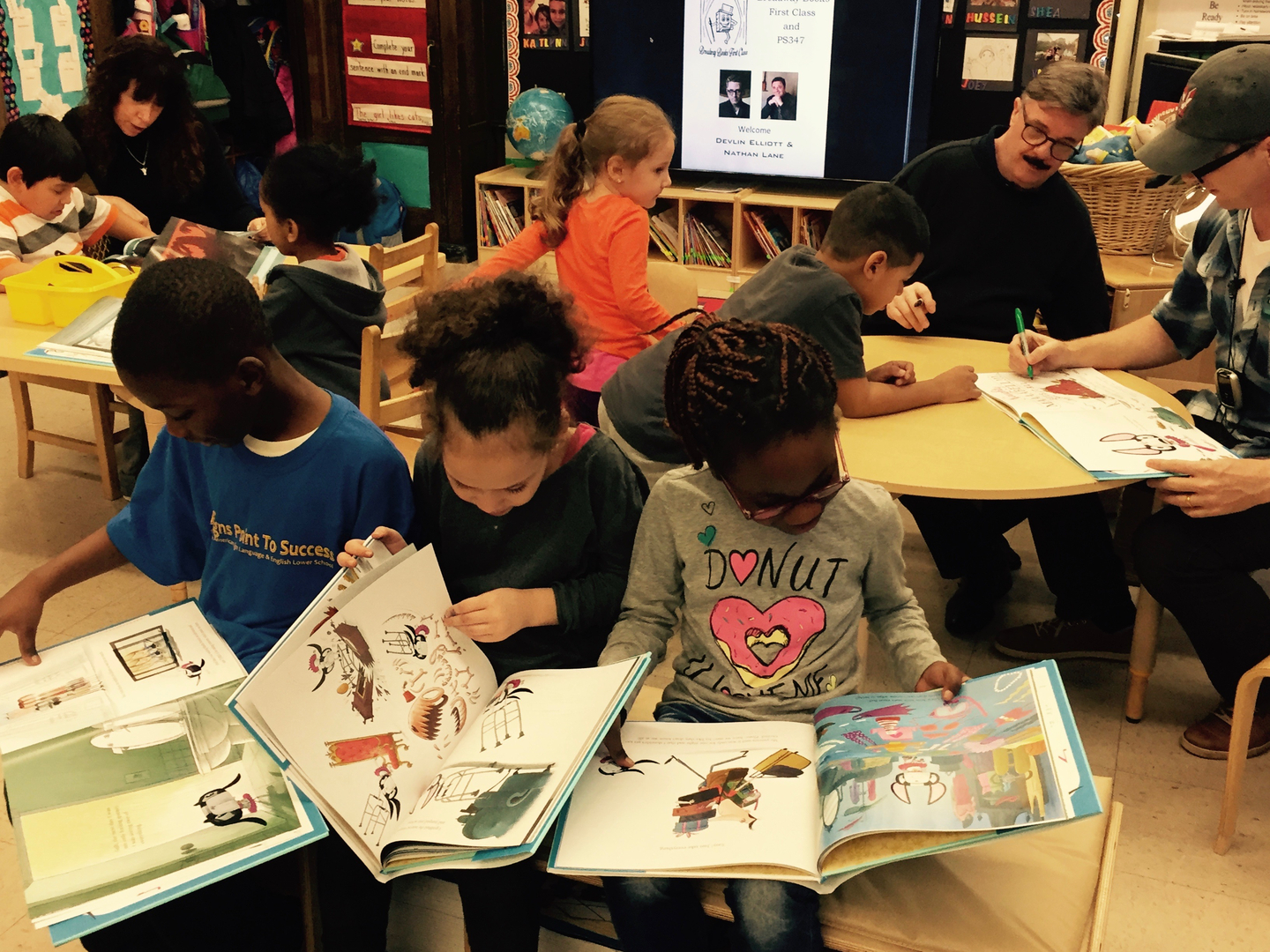
First graders learning naughty from nice with Devlin Elliott and Nathan Lane

I used to love rainy days when I was growing up. Those dark, comfortable afternoons brought a fresh, earthy scent wafting on the breeze through our open windows. I couldn't go outside to play with my brothers and sister so we would happily occupy ourselves inside with board games, coloring books, toy cars and our imaginations. Eventually, I'd slip away to find some blissfully snug spot and read.

Those comforting memories often revisit me today when I'm in my classroom with the rain tap-tap-tapping on the playground outside our window. That long ago feeling of cherished togetherness and safety returns to envelop me and my first graders.

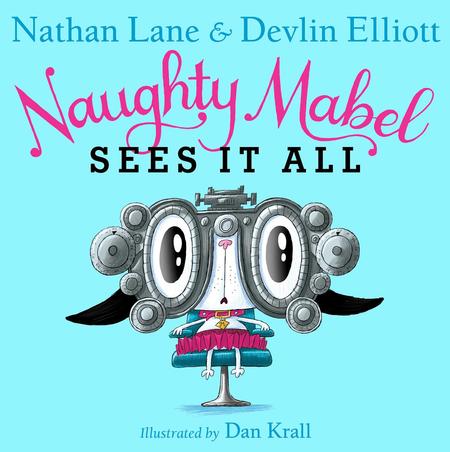
It was one of those stormy, relaxed days when we metaphorically curled up with Devlin Elliott and Nathan Lane's latest book Naughty Mabel Sees It All.

What could be better on a rainy day than welcoming these visiting authors into our peaceful space to share the latest antics of their darling, Mabel?

The children introduce themselves to Devlin Elliott and Nathan Lane

Tony Award nominated producer - and charmer - Devlin Elliott is a returning guest to Broadway Books First Class. He visited during the first year of the program and happily accepted my invitation to come back a second time. This time he brought Tony and Emmy Award Winner Nathan Lane.

Nathan famously voiced Timon, the meerkat, in Disney's animated blockbuster The Lion King. That tidbit was not lost on my excited first graders who relished the thought of meeting the man behind Timon. We sang and signed our hearts out to "Hakuna Matata" and "Circle of Life" in preparation for our guests. In fact, we did quite a lot to prepare for our visit.  We learned about Nathan's job as a stage and film actor. We came up with a list of questions about the role of a producer, how actors and producers work together and about favorite roles and memories.

Devlin and Nathan did some preparation too. In addition to carving out the time in their busy schedules, they also generously offered to provide each child in the class with his or her very own copy of their book!

After introductions, conducted strictly in American Sign Language, we focused our attention on an energetic French bulldog named Mabel, whose ocular mishaps lead to a visit to an "optimist, an optopotamus, an op-tha-mo-lo-gist...Oh, you know, the eye doctor".

Nathan Lane masterfully read the book, stopping periodically for children's questions or simply to laugh amusedly at their quirky commentary. Devlin encouraged playful interaction during the reading to allow for close inspection of Dan Krall's illustrations. Also, never underestimate the humor inherent in a character passing gas (sound effects - as Devlin and Nathan know - only elevate the hilarity).

Devlin Elliott and Nathan Lane reading Naughty Mabel Sees It All with ASL interpreter  Lynnette Taylor

Naughty Mabel Sees It All is a children's book, yes, but like the best children's entertainment it is also chock full of references to keep the adults interested. I ask you, how many children's books hilariously reference Bette Davis as a wide-eyed, slightly off-her-rocker Baby Jane Hudson?

A very lively round of questions and answers followed the reading. We learned that producers generally do not really have much direct interaction with performers, except perhaps on opening night if the show goes well.

Nathan shared that of the many plays and musicals he's performed on Broadway his favorite tends to be whatever he is doing at the moment. He explained that he is currently performing in The Front Page and quipped, "It's about the newspaper business, which I'm sure you'll be fascinated by" (decidedly not a show for children). His "for young audiences" description of his character in the show, Walter Burns, who is a "ruthless, not-so-very-nice man" had the adults chuckling. He went on to explain that he likes to play the "mean guy" because they are always the most interesting and "do not see themselves as mean because they think they have a good reason for what they do".

Devlin taught us about a producer's job in a nutshell; "Find the show, raise the money and know when to close".  Also that having passion for a project is satisfying and fulfilling. He is currently producing an innovative show called White Rabbit Red Rabbit.

Students enjoy reading their signed copies of Naughty Mabel Sees It All.
Thank you Nathan and Devlin for your generous contribution!

We concluded the visit with gifts. Devlin and Nathan signed copies of Naughty Mabel Sees It All for each child before biding us adieu. And that brings us back full circle to the purpose of their visit in the first place, which is to celebrate literacy and the Arts and to encourage more children to enjoy a good book on a stormy day.  I couldn't be more grateful!

Please Darlings, keep an eye out for Naughty Mabel on Nickelodeon soon!

Saturday, March 19, 2016

A Return to Teaching Tolerance


I am back as a writer for Teaching Tolerance after a necessary hiatus due to the demands of completing my doctoral studies.  

My lastest post entitled Confronting Creepy Crawlies and Implicit Bias is reposted below.

If you ask elementary school teachers to explain their everyday duties to the uninitiated, you will get a fairly long list of responsibilities residing outside the realm of reading, writing and arithmetic. There exists an unwritten—yet expected—job description that simultaneously demands we assume the role of parent, social worker and medical provider.
One example: Many teachers are accustomed to putting on plastic gloves and maneuvering pencil erasers to check small heads for nits (louse eggs) and head lice. It is an “Eek!”-inducing affair that causes most of us to scratch at imaginary bugs for hours afterward. Yet, we brave the creepy crawlies in the best interest of the child. If we find nits, a letter is sent home informing the parents and providing instructions for how to get rid of them. If active lice are found amongst the hair follicles, the school nurse takes over and the child is sent home for treatment.
The cycle of screening and treatment usually continues for several weeks as the critters enjoy the hospitality of their young hosts and outbreaks remain a daily occurrence. The added concern of bedbugs permeates our diligent search for tiny insects.
It is no surprise, then, that this becomes a topic of discussion amongst teachers. It freaks us out. It makes us uncomfortable. It also provides a showcase for some of our implicit biases when we try to figure out how it all began.
Implicit bias, as described by Zaretta Hammond in “Is Implicit Bias Racist?,” are “the unconscious attitudes and beliefs that shape our behavior toward someone perceived as inferior or as a threatening outsider.” Teachers operate within unquestioned assumptions every day. We all do. In cases of lice and bedbugs, I started to notice how we perceived some students as “more likely” to introduce them into the classroom environment based on things like socio-economic status. In one instance, everyone figured it was the boy whose illiterate parents lived with him in a shelter, but we were surprised to learn that, no, it was the boy with educated parents living in a middle-class home. Digging deeper, I began to notice how these assumptions trickled down into other aspects of the day, from who got hugs to speculations about which parents read with their children.
Hammond offers tips to bring implicit bias to consciousness. These begin with checking our assumptions and looking for patterns of inequality, which have relevance in terms of lice. Our biases can influence our behavior in subtle ways, yet children perceive our unspoken attitudes even if we are not quite clear about them ourselves.
Thankfully, we can test ourselves for hidden biases surrounding stereotypes and prejudices. A little self-knowledge coupled with a smidge of education about the actual repercussions of nits, lice and bedbugs can help assuage potentially hurtful interactions stemming from unintended discrimination.
After doing a check for critters, if I find any, I always initiate a class discussion to gauge reaction and promote understanding. These talks not only help the students but also serve to reinforce an empathic, educated response from any adults in the room.
Next, a read aloud of David Shannon’s book Bugs in My Hair! allows us to approach the topic with humor. Never underestimate the value of an amusing illustration or characters whose over-the-top reactions allow readers to laugh and learn simultaneously.
Finally, we share some facts:
  • Anyone is susceptible.
  • Lice are annoying but ultimately harmless.
  • If an outbreak occurs, keep long hair pulled back, refrain from daily washing (lice do not like dirty hair or hair with product in it).
  • Treatment can be found with over-the-counter delousing shampoos and nit combs.
  • Wash clothing and bedding in hot water, vacuum rugs and place what you cannot wash or vacuum in plastic bags for two weeks to kill lice.
Most of all, lice are not a commentary on cleanliness, education or socio-economic status. They are simply a result of close interactions amongst children and an unfortunate reality in elementary school classrooms. We may not be able to change that, but we can certainly change how we respond.

Saturday, February 27, 2016

F@#*%D UP


As I sat with my class of six-year-olds on Friday morning - cozily discussing the nuances of language - an announcement on the school loudspeakers let us know that a soft lockdown had begun.

Quietly the children stood up, walked over to their designated spots and hid.  There was no need for discussion because they knew exactly what to do.  When I turned back around after locking the classroom doors I couldn't help but feel impressed that they executed this drill so beautifully.

These drills are a testament to our unfaltering ability for adaptation in difficult times but they are also a sad commentary on the threat we are forced to accept.

When I joined the children a sleepy-eyed little boy calmly asked, "Is someone going to come in here with a gun and kill us?"

He was very matter-of-fact.  He was curious but did not seem afraid. I tried to match his tone and reassured him that this was only a drill.

He responded, "Oh, good. I don't want blood all over the floor"

It was all a little too much to consider...for both of us.

Then he got quiet.  I got quiet too.

I am still quiet.

Sunday, September 20, 2015

First Impressions

The school year is underway and we are off to a wonderful start. Each year I wonder about the dynamic of the class.  How will the class inhale and exhale as we find new life together?  What adjectives will describe the interplay of our shared experience?

The gestalt is more than my individual interactions with each student.  Individually they bustle about with their own stories but when a group of children are asked to coexist in one space it isn't always easy to predict the outcome.  In years past we've characterized a class as "deep thinkers" "learners who need a lot of visual support and repetition" "inquisitive and high energy" and "fun and best suited to learning through exploratory play or games".

Our feeling this year - after only 6 days together - is that the makeup of our class is strongly defined by the sweet nature of our students and their desire to be good.  This means they clearly want to please us even as they push boundaries a bit.  I remember wanting to please my teachers too.  I wanted that recognition of a job well done or acknowledgement of my effort.   I saw this as what was meant by being fair. My intrinsic motivation was somehow intertwined with the extrinsic.

The goodness of our children can be seen in the way a little boy enters the room and after putting his things away, sits on the rug to wait for the morning to begin.  How another boy carefully arranges the superhero book bin so all the covers are facing out.  We see it when 2 girls decide they shouldn't sit together because they distract one another or when another child picks up a crumpled piece of paper that has been sitting under a table and throws it in the garbage.

Our first impressions will change and grow throughout the year but I do believe we are off to a good start.  I see that my smiles, words of encouragement, subtle forms of acknowledgement and fairness will impact these children perhaps more than they have other classes.

I will be careful to remember the impact of my role as their teacher. Teachers - and all adults - can make a situation fun or a horror show depending on our reaction to a given situation.  We can choose to become upset and dismissive or understanding and laugh off the inevitable mess children create.  I choose to laugh.  The trick is to follow through on these good intentions even when I am exhausted or sick or stressed out.

First impressions!  I wonder how we - the teachers - did.  How will this class characterize or define us?

LinkWithin

Related Posts with Thumbnails