Showing posts with label Assessment. Show all posts

Monday, August 28, 2023

The Science of Reading


The Science of Reading is an educational finding, based on research, which attempts to unravel how humans become literate. Many school districts in the nation are currently embracing the findings and implementing them into elementary school classrooms. The basic premise is that educational institutions have gotten reading instruction all wrong and an update in the operating system is necessary and overdue. 

All of this is beautifully presented in a podcast entitled Sold a Story by Emily Hanford. I listened to all 6 episodes yesterday on my drive from Rochester, NY to Trenton, NJ. It is an engaging investigation into reading theory, history, and implementation. It should be required listening for educators, especially those who have not gotten this information in their training programs.

As a reading specialist, I already knew most of the information. Yet, there were some surprises (I'll get to that in a minute). I've lived through a range of the educational approaches about reading presented in this podcast. I remember phonics-based instruction as a child with worksheets asking me to circle the long vowel in a series of words. I also remember my confusion because I was never told what that meant. What made a vowel long or short? A bit of explicit instruction would have been helpful and my early experience influences my teaching today because I know what it is to be the child who benefits from explicit instruction. 

Over the years, the pendulum has swung between phonics-based instruction to wholistic methods and back again. Things shift as we learn more and, it seems to me, they shift because people simply want something different. We also cannot ignore the influence of financial greed and political gain in how schools are run. All of this is covered in Sold a Story.

The bottom line is many schools are now throwing out the work of Marie Clay, Lucy Calkins and Fountas & Pinnell to focus on phonics. In my training and work with hearing students, I've always incorporated phonics instruction and was surprised to learn -  in the podcast - that Marie Clay's Reading Recovery and Fountas & Pinnell's Leveled Literacy Intervention considered it optional.  That was never how I implemented their work. For this, I give thanks to my mentor, Dr. Joanna Uhry, who taught me the value of matching my instruction to meet the needs of the children rather than providing a one-size-fits-all approach. 

This "new" direction, propelled by the science of reading, comes with questions. Questions regarding assessment and instruction that administrators and coaches, who know much less than I do, are undoubtedly going to struggle to answer. I just hope we do better for our struggling readers and can one day celebrate an America with higher literacy rates because to paraphrase Whoopi in Ghost, we in danger girl.

Sunday, November 8, 2015

Reviving Miss Nancy

Miss Nancy of Romper Room
Ah, education!

Your pendulum swings with such force from one "fresh" ideology to another but the only things that are new again are the superficial wrapping and arbitrary labels.

This past go 'round was particularly ugly.  The last few years have been virtually joyless, abusive and heartbreaking for teachers. Thankfully, that is changing.  At least in my little corner of the world.

Our school is returning to the Teachers College Columbia University Reading and Writing Project for literacy development.  Their curriculum actually teaches children how to read and write in a developmentally appropriate manner.  

It is such a pleasure to receive educational guidance from folks who know how children learn. This is a great departure from curricula developed by test makers posing as educators.  We'll be dealing with the damage they caused for many, many years (I am looking at you Pearson!)

The one drawback is the way the literacy coaches from the Reading and Writing Project teach and interact with students.  They all seem to be emulating the over-the-top style of 1960s Romper Room television hosts welcoming children or peering through the Magic Mirror.


I am not sure why the coaches all seem programmed with a robotic Stepford Wives computer chip of congeniality but I'll take maniacal smiles over disapproving scowls any day.

Don't be surprised if you walk by my room one day and catch me muttering,

Romper, stomper, bomper boo.
Tell me, tell me, tell me, do. 
Magic Mirror, tell me today,
Did all my friends have fun at play?

Wednesday, August 19, 2015

Defending the Early Years

CCSS 1.OA.D.8:
"Determine the unknown whole
number in an addition or subtraction
equation relating to three whole numbers."
The Common Core State Standards (CCSS) provide fodder for debate amongst educators, researchers, administrators and the political machine that drives the incessant cycle of instruction and assessment.

We all go 'round and 'round but what are the main concerns?

This week I read an article released by the folks at Defending the Early Years (DEY) detailing Constance Kamii's critical examination of the K-3 CCSS for math. The piece clarified some of the issues.

The article states that DEY is "an organization of early childhood professionals dedicated to speaking out with well-reasoned arguments against inappropriate standards, assessments, and classroom practices.  We are concerned about the rising emphasis on academic skills in early childhood today.  Increasing teacher-directed instruction is leading to the erosion of play-based, experiential learning that we know children need from decades of theory and research in cognitive and developmental psychology and neuroscience" (Emphasis is mine)

The issue Kamii has with the CCSS seems to rest with the fact that educators are now being forced to replace child-centered experiential learning - through play and inquiry - with developmentally inappropriate instruction. This is huge. In essence, she argues we are teaching skills in first grade that children will master without instruction in second grade (and so on).  Why the rush? Why are we wasting the child's time? More importantly, is the sacrifice worth the price when you consider what is lost?

As an educator, I am not resistant to the CCSS. My experience with implementation has been mostly positive.  The majority of my first grade students - with the exception of my English language learners - excel at math. They enjoy tackling the challenging material and using different strategies to solve complex word problems and equations.  I had trouble understanding the hubbub and derision surrounding the practical application and value of the CCSS.

The take away from Kamii's article seems to be a matter of could vs. should.  Just because children are capable of doing the work, is it in the child's best interest to do so?  Is the "forced" and "inappropriate" learning merely surface level "verbalisms" lacking depth of understanding?  I cannot answer that or fight the machine to alter that expectation.

What I can do is remain diligent and strive to achieve a well-rounded curriculum for my students while operating within the confines of the CCSS.  One that includes time for the arts and allows for child-centered learning through blocks, dramatic play and student-led social interactions.

As the CCSS are tweaked (or eventually thrown out) I can provide children with daily, meaningful learning experiences.  Teachers can still make a difference.

Sunday, March 22, 2015

Mistakes


Oni and I are diligent about establishing and maintaining a positive classroom culture.  We want our students to safely explore those risk-taking challenges that push them towards an A-Ha! moment.

Our beliefs are couched within the premise that in order to own the learning our students must enjoy the ride.

Kids in First Grade do not have it easy these days.  We assess and test their progress at every turn.  Recently within a two week period they had a social studies test, performance-based assessments in writing (both formative and summative), an end-of-unit test in Fundations (on the building blocks of reading), Diagnostic Reading Assessments (to establish independent and instructional reading levels), and a 24-Question math test on comparing numbers (it's more difficult than you might think).

We always frame the assessments within the parameters of the fact that it helps us teach them better.  Tests and assessments let us know how we are doing.

To promote this "It's okay to make mistakes" mentality one student brought in a picture she found and colored which read, "Mistakes are proof that you are trying".

She shared it with the class and -- with a spirit I heartily applaud -- another little girl defiantly stated, "No!  I make lots of mistakes and I don't try!"

It is impossible to impart how much I loved her screwed up face and confusion as she tried to wrap her head around that golden nugget of wisdom.  It showed me that she is always questioning.

And that is something I encourage most of all.

Sunday, February 2, 2014

Data Collection

Yippee!!

Data collection for my doctoral research on reading assessments used with children who are deaf and hard of hearing is just about complete!

I am eternally grateful to the teachers, district superintendents, school principals, academic directors and generous researchers who have supported my work. The aforementioned have helped spread the word and/or given their precious time to complete my short online survey.

Originally, I optimistically anticipated I could generate over 100 responses in just four weeks. In reality it has taken about 16 weeks to reach that goal. The process of spreading the word has been an involved and time consuming task.

It has also been quite amazing. I have not started the process of formal data analysis but the surveys and interviews have given me much to ponder. It is an exciting time!

I anticipate closing the survey on February 14, 2014 - a personal Valentine to myself.  This means there is still time for anyone who meets the criteria to participate.

Qualifications to participate in this study are:
  1. Teachers currently working with K-5 students who are deaf and hard of hearing.
  2. Teachers working within the Northeast Region of the United States (New York, New Jersey, Pennsylvania, Massachusetts, Connecticut, Maine, Vermont, New Hampshire, Rhode Island, Maryland, Delaware and Washington, D.C.
  3. Teachers involved with teaching and assessing reading development for students who are deaf and hard of hearing.
If that is you (or someone you know) please take 10 -15 minutes to complete the survey.  The link can be found here.

Finally, a big THANK YOU to my wonderful coteacher Oni for helping me create this short ASL video to promote the survey.  Ain't she sweet?


Monday, June 3, 2013

When Education Goes Wrong

The end of the school year is rapidly approaching.

This is the first time in memory that I am counting down the days and looking forward to walking away.  I love the children and their families but the state of education has deteriorated to the point of disbelief and I need to step aside for a moment.

I wonder, "How did we fall so far?"

It becomes difficult to remain optimistic and passionate about teaching when every day the chisel chips away at creativity and respect.  The Department of Education has placed value only on the most superficial and mechanical aspects of what it means to educate and to learn.

Teachers are given scripts to follow and judged on how well they comply with the robotic recitation.  Teaching artists who thoughtfully weave content and excitement with knowledge of the students and the material are looked down upon (or talked about behind their backs) for displaying a "rebel" nature.

Educators are now assessed on bulletin boards and charts instead of genuine student learning. Of course, that is hard to quantify isn't it?

It is happening all over the city, the state and the country.

And what is even more distressing is the rigid and misguided devaluing of the children we aim to teach.  Their natural curiosity and desire to figure things out becomes squelched in sacrifice to myriad high stakes tests.

A friend sent me this video of a TEDxTalk with Dr. Nancy Carlsson-Paige.  Her words reflect my frustration.

“All these amazing capacities that children bring to us in education are cut out when we drill and grill them. And when we take the natural and powerful capabilities that children have out of the education equation, we take the love out of learning.  We take the joy out of learning. And we take it out for children but we take it out for teachers too because the great craft of teaching involves knowing how to harness those amazing capabilities children have for the purpose of helping them learn in school” 

I suppose I can find some solace in the fact that I have a principal who believes in the work I do and has confidence in my abilities. That trust is certainly valuable but at the moment most teachers are the proverbial dog who gets kicked when daddy (or mommy) is stressed.

Teachers would appreciate a bone every once in a while or at least a pat on the head.

Saturday, August 11, 2012

A System of Tens

I know I am not alone in when I write that math has never been one of my favorite subjects (except for algebra, which I loved).

So, who'd have thought that I'd have fun spending 4 days (25 hours) discussing...

The Commutative, Associative and Distributive Properties

Algorithms

Compensation Strategy

Mental Math

Identity Property

Order of Operations (PEMDAS)

Constant Difference

Decimal Points and Percentages

The way we teach math nowadays is a far cry from the "Yours is not to reason why, just invert and multiply" mentality of my childhood. It is unsurprising that I am lacking mathematical confidence after an education wherein traditional algorithms replaced an understanding of how numbers work.


I learned to "carry the one" but wasn't taught that the "one" was actually a "ten".

Today the traditional algorithms for addition, subtraction, multiplication and division are taught after the children have developed an understanding of our number system.  In kindergarten we explore basic numbers and each successive grade builds on that understanding.

It's truly incredible to listen to children explain how they mentally solved a math problem by manipulating the numbers into "friendly" or "landmark" numbers and giving the parts meaning. For example (taken from the book pictured above), 38 + 25 could be solved as 30 + 20 = 50 then 8 + 5 = 13 then adding these two numbers together  to get your answer 50 + 8 = 63. Or another child might try it this way, 38 + 2 = 40 then 40 + 20 = 60 so 60 + 3 = 63.  There are so many possible ways to figure this out and the tradition algorithm is simply one of many.

Interestingly, once children develop number sense, the traditional way I learned of "borrowing" and "carrying" becomes the most confusing, complicated one of them all!

Kudos to our workshop leaders, Kerry and Christina, for making me as smart as fifth grader!

Helpful Resource: 
Check out the Common Core Alignment Guidance for Everyday Mathematics. Lessons in Everyday Math are color coded according to relevance to the Common Core.  

Sunday, June 24, 2012

Graduation

The end of the 2011-2012 school year is in sight.  Only three days left until summer vacation and a much needed (deserved) rest.  It has been a fun, yet hectic, year full of change.

The past few days have been no exception.  Report cards, end-of-the-year assessments, portfolios, celebrations, moving up ceremonies and graduations have occupied much of our time.

Our fifth graders had their graduation ceremony on Friday and this Tuesday the eighth grade students will don cap and gown to collect their diplomas.

Many of them were once my Pre-K, kindergarten and/or first grade students. So, when they were asked who they would like to have speak at their graduation they voted for me.  It feels as though we have come full circle. I once welcomed them to school and now they are welcoming me as they embark on a new chapter in their lives.  It's an honor.

They keep asking me if I have written my speech yet and I continue to say, "not yet".  I'm generally better unscripted but I do have an outline. Since I am closely associated with a particular little monkey I plan to construct my talk around life lessons learned from Curious George (kinda, sorta like those found here and here).

I also plan to bring along some small stuffed Georges to throw out at the graduates every so often.

Just to make sure they are paying attention.

*A bit of a follow-up

I am told the speech was a grand success.

The five life lessons I chose to impart to the young graduates as they set out on their adventures were...
  1. Enjoy life!
  2. Help Others
  3. Be Curious and Creative
  4. Love What You Do
  5. Surround Yourself with People who are in your Corner (like The Man in the Yellow Hat)

Sunday, April 29, 2012

More Than One Perspective

I read a frustrating article in New York Teacher yesterday entitled Teaching Children who are Hearing-Impaired.  

Hearing-Impaired.

Those words alone are indicative of a perspective that views children who are deaf and hard of hearing as lacking, damaged and in need of fixing.

I do not take issue with the author who comes across as a passionate, caring teacher eager to share her experiences in order to edify new teachers in the field of deaf education.  She provides a few helpful suggestions about FM units and how to use interpreters but one "tip" had me shaking my head.

She writes, "Hearing-impaired youngsters are concrete learners and often have difficulty with abstract concepts.  We have to ease into such concepts."

This statement is reminiscent of one presented during a workshop I attended on assessment and intervention for students with "hearing loss and other disabilities".  The keynote speaker said that hearing-impaired children lack the ability to communicate with others and this inability to access language has a negative impact on social skills and abstract reasoning.

I take issue with these blanket statements because they are misleading. While this may be true for some children who are deaf or hard of hearing it is not true for all of them.  And it is certainly not true for those culturally Deaf children who have had access to a visual language since birth.  (Is that a blanket statement?  Oops!)

When it comes to education one size does not fit all.  Sometimes an oral approach with speech therapy is successful and sometimes a signed environment best meets the needs of a student.  It's frustrating that both sides of the oral vs. manual debate cannot put forth all the educational options for parents.  Too often doctors give misleading or one-sided information--keeping parents in the dark--to push their own agendas.

Why can't we all just play nice?

Sunday, April 8, 2012

Nothing Without Joy

Balance!

In one corner of the ring stands learning that is fun, motivating and engaging.

In the other--commanding cheers from a bloodthirsty throng--hails education that is rigorous, standardized and structured.

Who will win this ongoing battle?

It is a fight teachers wage every day in every lesson.

But I ask myself, "why must the two be separate?"  Teaching and learning can be both captivating and challenging.

Why are educators today being asked to choose?

Of course, in reality the struggle is much more subtle than two opponents duking it out in a wrestling match.

Rigor comes along wearing the multi-hued uniform of performance tasks, formative assessments and standardized tests. It continually exerts pressure and tries to edge out joyful classroom investigations.

Luckily for me I had a heaping dose of the Reggio Emilia "Nothing Without Joy" philosophy this past week courtesy of my friend and inspiration Lisa Burman.  Lisa was the AUSSIE literacy coach for our school for many, many years.  She championed teaching that respected the many languages of children in an organic, unhurried atmosphere.

Over a beer we discussed my concern that I was letting go of some of the joy in order to make way for rubrics, progress charts, compliant bulletin boards and scripted curricula.  She, in her brilliance, helped me see a way to navigate the demands of the Common Core Standards and the child-centered work we have been doing at our school for more than a decade.

It turns out I wasn't really veering too far off the path.

Rigor?  Of course!

Joy?  Always!

I lift a glass to you dear Lisa!

Sunday, January 29, 2012

Performance Tasks

As the Common Core State Standards continue to roll out in NYC, teachers have begun to assess student progress through a series of performance tasks.

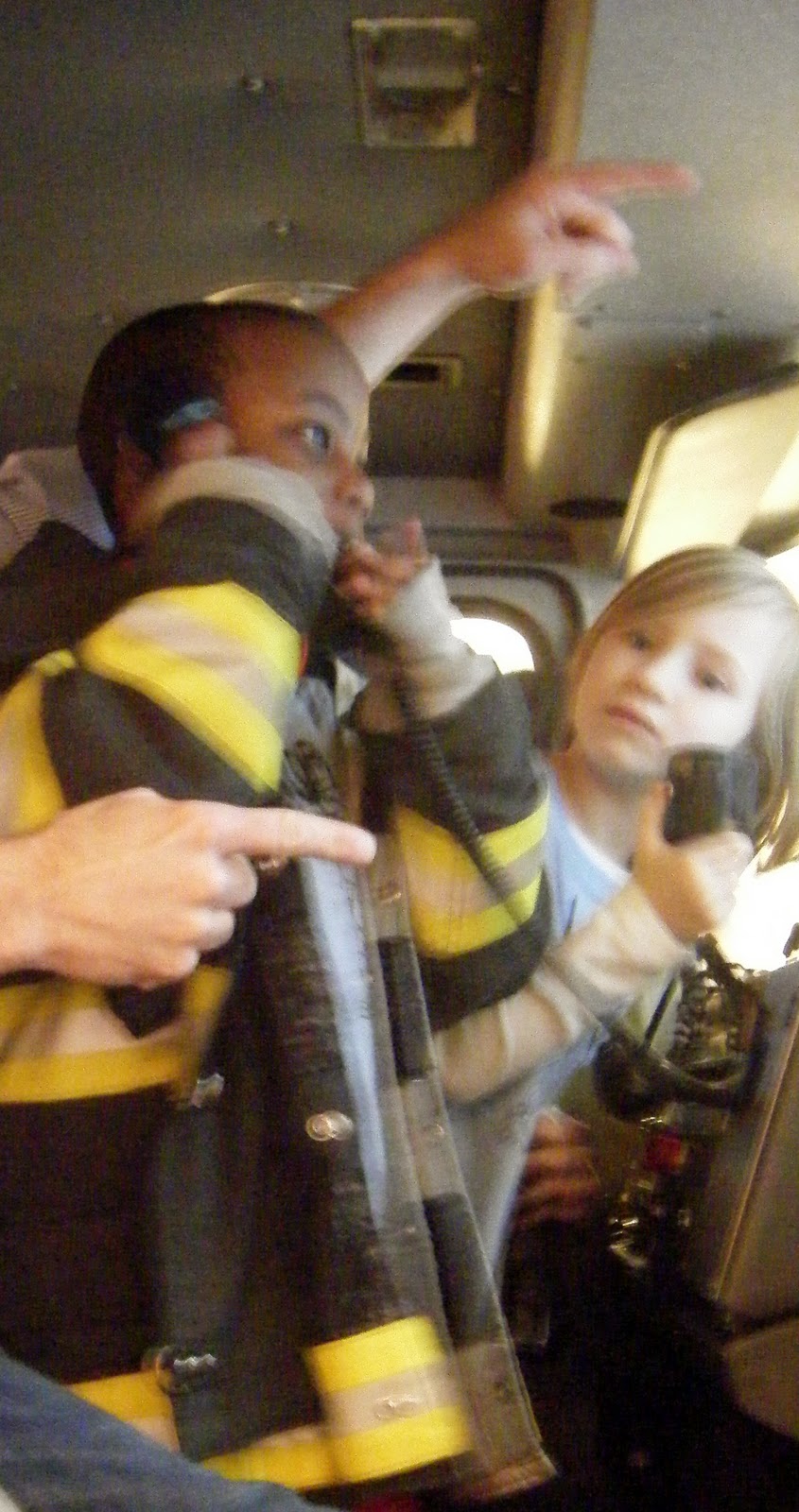
In first grade we created a performance task for a unit on narrative writing centered on our recent trip to the FDNY Fire Zone.  We reasoned that writing about a shared experience would "level the playing field" allowing us to compare/contrast student work fairly.

At the Fire Zone students learned about fire safety, played in a real fire truck, dressed as firemen and practiced what to do in case of a fire.  This educational trip was exciting and a bit frighting at times for the students.  It was also something they all wanted to write about which provided excellent motivation to complete the performance task.

The task, as told to our students,  was to "write about our trip to the FDNY Fire Safety Learning Center and include some details about what happened at the beginning, middle and end of our trip.  I expect you to go through the writing process to revise, edit and publish your work".

We set a flexible timeline allowing for students to work at their own pace. The first four stages of the writing process (pre-write, write, revise & edit) were done independently with only minimal support but we intervened at the publishing stage to ensure that the finished piece was generally free of grammatical errors.

Once a published piece was completed we asked our students to fill out a self-assessment rubric on the writing they just finished.

Although performance tasks are new to me, I did enjoy the process (this is the third performance task in writing this year, others included persuasive writing and opinion writing pieces).

Below is a sample of one student's work including pre-writing, writing, revising, editing and reflection.

PRE-WRITING


WRITING, REVISING & EDITING


PUBLISHING


REFLECTION


At this stage, we evaluate their performance using a rubric based on our expectations.  A score of 3 in any domain indicates the student is meeting expectations while a score of 4 is exceeding expectations.  Scores of 2 and 1 indicate a student is approaching expectations or is far below grade level expectations respectively.

Our rubric is below...

Call out to teachers - How do you utilize performance tasks in your classrooms?

Saturday, September 24, 2011

kidwatching

I have been rereading the book Kidwatching: Documenting Children's Literacy Development by Gretchen Owocki and Yetta Goodman in preparation for the Master's class I am teaching at Fordham University and am once again stuck by the message in the preface.

I am sharing it here for all of those passionate teachers out there and encourage you to give this book a read.

I am the teacher who is committed to discovering what each of my students knows, cares about, and can do.

I am the teacher who wants to understand each of my student's ways of constructing and expressing knowledge.

I am the teacher who helps my students connect what they are learning to what they already know.

I am the teacher who respects the language and culture my students learn at home, and who supports the expansion of this knowledge at school.

I am the teacher who knows that there are multiple paths to literacy, and who teaches along each child's path.

I am the teacher who is committed to social justice and to understanding literacy as a sociocultural practice.

I am the teacher who believes that each child can teach me about teaching, language and learning.

I am the teacher who believes in the interconnectedness of language, learning and life.

I am the teacher who supports children in writing I can! on their wings.

I am a kidwatcher.

Sunday, September 18, 2011

Hopes for First Grade

At the start of this school year (just last week) we asked our students what they hoped to learn in first grade. We gave them a sheet of lined paper and sent them happily off to write.

The stories they created will serve as our baseline writing pieces - to be analyzed in conjunction with a writing rubric - so we can determine the next steps in writing development for each child. The baseline writing will also aid us in providing differentiated instruction for the children in our class.

I have discussed the writing process in the past (click here to read more) so I won't do that in this post, but it is evident from the selected compositions below that our students represent a wide spectrum on the writing continuum.

I will share them in order of development.

"I want to learn how to read books."

"I want to learn about monkeys."

"I want to learn about planets. I want to learn about the planets temperature."

"Flowers pop out! I want to do for first grade is to learn how a flower pop out I want it to be yellow and brown sunflower and I want it to be big and I want it beautiful and bigger the best flower in the world and I can ..."

"Science - I want to make an experiment. And I want to make flowers and I  want to make a clay dog and I want to make a potion."
We have a fun road ahead of us as we delve into capital letters, spacing between words, punctuation, grammar, syntax, spelling, content and handwriting (among other things) and I can't wait!

I wonder how I would have answered this question in first grade.

Monkeys perhaps?

Monday, August 15, 2011

Beating Bliss

I love the title of this post because it is so ambiguous.

Anyway...

Teaching is a gift that fills me with immense gratitude but there are aspects of it that make me want to scream. And as my summer days drift away I've realized how long it takes to heal from those occasional beatings.

The 2010-2011 school year was probably the toughest in my 15 years because the pressures of teaching to the test instead of teaching to learn have seeped into even our school, formally a bastion of authentic exploration and child centered learning.

We are all feeling the pressure of the American educational system which creates an environment wherein passing standardized tests is considered the Holy Grail.  We are stepping away from trusting that teachers are capable, experienced and knowledgeable enough to tailor lessons to meet the individual needs of each child.  Instead scripted text books and programs are becoming de rigueur.

Stripping educators of the right to be creative artists and forcing us to become homogenized, one size fits all automatons devoid of intelligence is insulting and infuriating.  All the while the test makers, who also create the text books needed to pass said tests, are happily counting their money.  It's all about making a buck - not education.

And the situation does not seem as though it is going to improve any time soon.  Our students thrived academically this past year.  They really did. But I mourn the fact that we did not have time to engage in deeper explorations as we have in the past with our investigations into the hot dog stand, the library, the bakery, hotels or teeth.

In the 2011-2012 school year I am committed to find a better balance between the hearts and minds of our students.  It is not an easy challenge but I am determined to fight for the rights of children who are paying the price of losing their childhoods stressing over achievement instead of taking in the small wonders all around them.

Wednesday, July 6, 2011

Was ist Kindergarten?

It has become increasingly clear to me over the past several months that there exists a baffling misconception about what takes place in a kindergarten classroom.

So, to help clarify false impressions perhaps it is necessary to answer the question "What is Kindergarten?"

Kindergarten (literally translated from German as "children's garden" which I like because it conjures the image of lovingly cultivating growth in children) is the first time many children are exposed to formal schooling.

Across America kindergarten programs vary in structure and philosophy. In some states kindergarten is mandatory while in others it is not.  In some classrooms children are taught to read while in others they are taught readiness skills.  However, in all kindergarten classrooms children are learning to interact with others in a social environment without the presence of a parent.  It is a time of burgeoning independence and surmountable challenges.

Kindergarten today is a far cry from the one we remember from our collective childhoods. Gone are the cozy blankets at nap-time, the four-hour days, the endless play.  These are replaced by rigorous curricula in reading, writing, word study, science, mathematics and social studies as well as classes in art, music, physical education and in our school American Sign Language.


Student progress is documented to show growth in all areas through anecdotal records, observations, formal assessments and portfolio collections. Conferences are held with each child, in each academic domain at least once a week.

Of course, there is time for exploration, imagination, enjoyment and that ever important element: play.  There is an expression we have adopted at our school based on the Reggio Emilia approach to learning. It is "nothing without joy".

Kindergarten may be more challenging for the "kinder" than I remember as a child but this quote keeps things in perspective and in balance.  If a child wakes up looking forward to school each day, I have done something right.

Tuesday, March 22, 2011

Math Games

Kindergarten math is predicated on the belief that children require lots of hands-on practice to understand the concepts underpinning mathematical reasoning.  For this reason, many early elementary classrooms are equipped with a wide assortment of manipulatives and games. Manipulatives provide tactile, concrete items for the hands-on ingredient while games serve the practice component (as well as motivation).

Every day we strive to ensure that our students have an opportunity to engage in math games.  New games are generally introduced during whole class lessons and then placed in a math center for independent/partner/or small group practice.  Depending on the games chosen we will usually set-up about 3-5 different activities. At times children are assigned to a specific center (to build a particular skill) or they can decide for themselves where they would like to go.

This week we have been playing some old favorites and some new.  One of the new games is Egg Carton Math.  This game has three levels of difficulty, each one building on the prior.  At the beginning level students use an egg carton that has dots in each depression that resemble those found on dice.  Two tokens are placed in the carton, the lid is closed and given a good shake.  When it is reopened the student must count (add) the number of dots under each token.  We also have our students write number sentences for each (see picture).

The second level (shown in the top photo) moves away from the all-dot scenario and mixes in numerals.  This encourages children to count on - meaning, for instance, if one token fell on the numeral 10 and the other on 6 dots the child would say "10" and count on using the dots as support. However, it is possible that both tokens would land in only dots (providing reinforcement of prior learning) or only numerals ( a more challenging task).

The third level in Egg Carton Math is to place only numerals in the egg carton.

Our AUSSIE math coach, Chris, introduced us to another popular favorite called "Racing to 100".  In this game children use a spinner (click on picture to see details) to become the first to fill up their cards. Each card has a space for 100 cubes.  When one row of 10 cubes is full the 10 cubes are exchanged for a stick of 10 (called a "long") and once the card has 10 longs that is exchanged for a "flat".

The description may seem confusing but the game is pretty straightforward.  It promotes counting by 10, 1 to 1 matching of number and object and concepts of number among other things.

As our students play we are free to provide guided math instruction with small groups (such as writing numbers) and observe/document student understanding.  It is a win-win situation for all involved.

Next stop...Vegas!

Saturday, November 6, 2010

Saint Bernards are "Just Right"

I love my "puppy" so much that, like a Wild Thing, I could just eat her up.

In kindergarten we have begun having our students read "just right" books.

"Just Right" books are books that children can read either independently or with a little support from an adult or more knowledgeable peer.  The books contain predictable text, usually with patterns (I see the dog, I see the boat, etc.), strong picture support and some easy sight words (I, my, the, etc.)

Based on current assessments most students could use some assistance tracking print with his/her finger (one to one matching) to establish word boundaries and use of initial letters to figure out unknown words and deepening comprehension of a text.

The latter can be done by questioning him/her during and after the reading about specific text items or extending the ideas in the book to his/her own experiences.

One of my favorite "Just Right" book series is about a Saint Bernard named Winnie.  The illustrator, William Benedict, must have certainly spent quite a bit of time around Saints.  He captures their charm, tenacity and brilliance in each picture.  I love them!


If you are searching for these types of books for your emergent reader take a look at Brand New Readers. Not only do their books feature Saint Bernards but there are also MONKEYS!

Just another reason for me to love my work!

Monday, April 6, 2009

Pilot Study

I have spent quite a large chuck of time this semester working on the pilot study for my dissertation.  A pilot study is also known as a feasibility study.  It allows the researcher to test run the instruments, assessment tools and/or methodology that will be later used for the grand study that will ultimately bring you to the completion of a Ph.D. program.

The pilot study paper is written like a mini dissertation.  It generally follows the five chapter structure of introduction, review of literature, research methods, research findings and discussion.

The absolute beauty of reaching this level of scholarly achievement is that the focus of your research is entirely up to you.  So, you are free to delve deeply into an area that you are passionate about. This is a good thing as you will be living with it for years.  (I am reminded of the phrase that doctoral students often repeat as they near the end "A good dissertation is a done dissertation".)

The title of my pilot study is Case studies of first grade Deaf readers: Looking at knowledge of conceptual signs and reading comprehension.  I had a different, rather catchy title there for a while but it was deemed too vague - no one could tell what my study was about.  I decided to go with the above title (for now) and save my clever, witty title for a book or at least a chapter in my dissertation.  I won't give it away just yet lest it be borrowed by some other fledgling researcher, can you imagine the horror?!

I chose to do a qualitative case study of two culturally Deaf first grade students and simply observe and describe how they use their knowledge of American Sign Language while they read independent & instructional level texts.

The new challenge of this for me was going through the process of gaining approval from the Institutional Review Board (IRB). In order to do any study with human subjects you must submit a proposal, gain permission from the subjects or their parents, the school (setting) and from the district.

I am told that completed pilot studies can be reformatted and submitted to educational journals for publication or academic conferences as presentations. It seems there are quite a few possibilities, especially if your area of study is the 'hot' topic at the moment.

We'll see.

For now, I am thoroughly enjoying the process and give thanks to those who are supporting me through it all; Dr. Marshall George, Dr. Joanna Uhry, Rebecca Marshall, Lauren Ridloff - Happy Birthday - and my fellow doctoral students (especially Cortney, Cayne and Linda).

What a fantastic journey!

Sunday, June 29, 2008

Reflections


Brilliant!

This last week I have been simultaneously wrapping up one teaching obligation and preparing for another.  First off I had to say goodbye to my precious little handfuls on June 26 - the last day of school. The last day of first grade for all of them, a time they will never get back. A time which will one day be a distant memory.  

Hopefully that memory will be one that makes them smile.  I know that they have given me many smiles over the past 10 months.  And although I will miss each and every one of them in ways unique unto themselves, I was ready to wrap up the school year and welcome other challenges.

I am teaching a course at Fordham University's Annual Summer Reading Institute for the second time.  The title of my course is Reading Skills for Children with Learning Disabilities. It is part of the Ennis William Cosby Hello Friend certificate program which teaches teachers more effective (systematic, sequential) ways to reach those students who tend to fall through the cracks of the educational system.  It is geared for teachers of young children, more specifically first grade students.  

According to Connie Juel "first grade is the critical year in the lives of young children: this is when they need to make essential inroads on understanding and acquiring the alphabetic writing system in order to make timely progress toward skilled reading." 

I know many teachers who share the same thoughts as one of my Fordham students when she wrote in her reflection paper "Then when I started student teaching I began to hear "Oh I would not want to start out in first grade...teaching kids to read I would not even know where to begin".  

But once you do gain the requisite knowledge (phonological & phonemic awareness, oral language development, alphabetic principle, differentiated instruction, etc.) it is amazing to see the kids take off.  The child you say 'hello' to in September is not the same child you hug goodbye in June.  

At least not in terms of reading and writing development.  For example here is a spelling assessment given at the beginning of the school year.  It is a measure of the child's skill at invented spelling. 

You can see that he knew a few CVC sight words like man, fat and hat. For the other words that he was asked to spell he put down the initial letter sound.  

He was at the beginning stages of writing development (farther along than the student who put down scribbles or random letters but not as far as the student who wrote an initial and final letter).  This gave me tons of information and I could target my instruction accordingly. 

By the end of the school year this is what he produced.

He was not only spelling many of the words correctly but this shows that he was using initial, final and medial letters.  He has an understanding of digraphs, blends and some familiarity with the silent /e/ syllable type.  In addition his handwriting has improved.  

Amazing! 

And it is not unusual to see this level of growth. It is leaps like this that make first grade such a rewarding experience, as a student and as a teacher.

As Lauren and I completed the final report cards it was evident that gains were made across all academic areas. But honestly nothing beats the enthusiasm of  these little learners.  I have always seen it as my true objective that each child holds onto their joy for as long as they can.  Do you still have yours?  

Monday, December 3, 2007

Injustices

On Friday night I met my blogging friend Steve for the first time at a bar called The Mad Hatter in New York City. This is the third blogger I have shared a drink with after getting knowing them first through the written word. In person Steve, Reya and Ched were pretty much as they portrayed themselves to be on their blogs - but even more charming, fascinating and interesting. Steve and I spoke briefly about the possibility that the persona someone chooses to put forth through a series of blog posts could be altogether misleading but the essence or 'stink of them' (to paraphrase Boy George) generally shines through.

And I think this can be said for the many roles we 'play' in our daily lives. In a sociolinguistics class I took recently we discussed the fact that each of us takes on a different societal role depending on the circumstances of our surroundings. We have rules of behavior or codes of conduct that determine how we interact in a business meeting as opposed to hanging out with mom and dad. But this is only a surface level manifestation of required etiquette. The character of the person underneath all of this determines how a conversation will play out or an interaction will unfold.

We have choices. We make choices all the time.

In education the choices we make can determine if we are part of the problem or part of the solution. And what 'they' say is true. If you are not part of the solution, you are part of the problem.

The sad truth of the situation is that everyone loves to blame everyone else for failures in education (and in life it seems) while crediting themselves with any successes. In my experience, it is those who point fingers who tend to be the most insecure, unmotivated and dangerous individuals around. The real person underneath is not so charming, fascinating or interesting.

Today we have a situation wherein our president blames teachers for the failure of schools even when it is his doctrines that have brought about the mad testing that keeps learning from happening. The No Child Left Behind legislation seems to be based on money. The testing companies are run by Bush cronies who are raking in the dough. And I naively believed at one point that the heart of NCLB was pure. What an idiot I was.

In Boston the average sixth grade student has only 53 days (out of 180 school days) where they are not being tested in one way or another.

In NYC upper elementary grade students have 24 full days of testing. This means that a whole unit of study is out the window. Teachers may have to put aside a study of poetry because the students are required to fill in little bubbles. Not to mention the time that is necessary to prepare the students for taking the tests. Teaching to the test instead of teaching to the child has become sadly commonplace. And the worst part is that these assessments are not given to plan instruction. They are given to label children and schools.

The blame game is not only reserved for the president. It is also evident on a smaller scale. In schools the third grade teacher blames the second grade teacher, who blames the first grade teacher, who blames the kindergarten teacher, who blames the parents, who blame the doctor, who blames the fetus, who kicks the dog. Oh, wait I got my wires crossed but you know what I mean. In this climate it is no surprise that the weakest teachers would feel threatened and point fingers before someone notices that they are not doing all they could.

Is it human nature to point fingers and shun responsibility?

I think perhaps it is. But I also think that it is the easy way out. And there are many folks who choose to work a little harder, give a little more and take a minute to ask "what can I do to make this better?"

So I remain hopeful even when I am a little disgusted.

That's all for now.

LinkWithin

Related Posts with Thumbnails